

Moran Staviski has traveled a turbulent road to become a beauty influencer, Bar Refaeli’s personal makeup artist, a personal coach, and an actress.
For the first time, she recounts how her father, who was mentally ill, died by suicide when she was 22, about the toxic relationship she escaped after nine years, about her dramatic debut role in the TV series “A Happy Place”, and how the nickname “Milky” became her trademark.
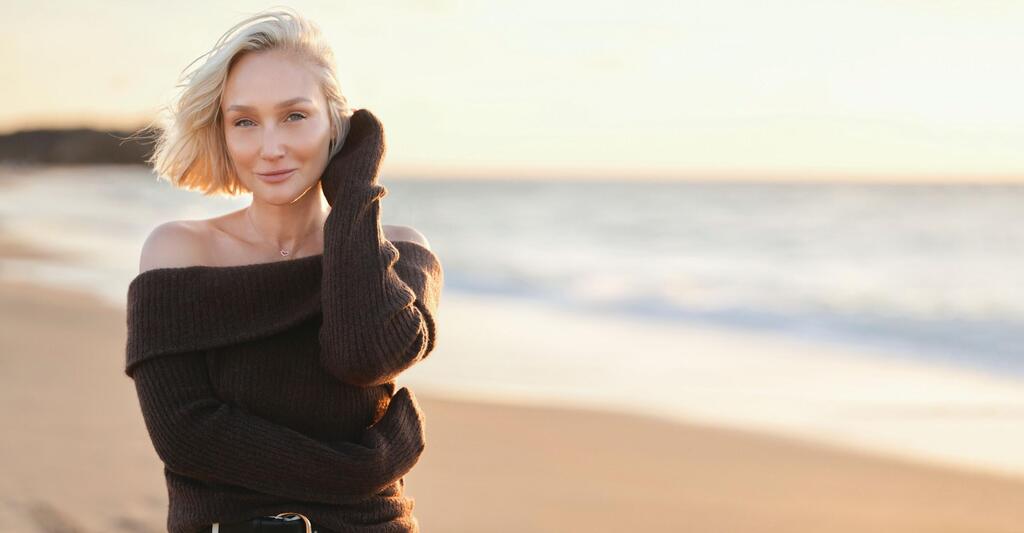
Her career began as an assistant to a well‑known makeup artist. One morning, she arrived at a photo shoot, not imagining what was about to happen. “It happened shortly after I quit modelling,” she recalls. “That morning I came to the set dressed nicely and happily, and my boss told me, ‘Baby, it will be very challenging if you come to the set looking like that, the girls will feel threatened.’”
That’s a tough remark.
“Yes. His intention was good, but I understood that I couldn’t come with all my light. For many years, I didn’t know how to contain that light, and I felt I was threatening others because of how I looked. Yet, I also felt that I wasn't pretty enough in the modelling industry, as you’re always told ‘no’. There was a big dissonance.”
So Staviski, who today is the personal makeup artist of Bar Refaeli and other stars, dimmed her light a little, to allow the women she was applying makeup for in the early career phase could shine wholeheartedly.
Over the past year she knew it was 'now or never', and went on to fulfill her dreams, all at once: she published a children’s book (which includes a card deck) about a rabbit searching for the spark and discovering it is inside him, a kind of allegory for her life.
Besides the book (which will be translated into English and distributed in the U.S.), she opened a coaching clinic specializing in relationships, after completing various training courses in Israel and abroad.
Now she also has her first dramatic role in the TV series “A Happy Place” by Noa Koler and Ram Nahari, aired on Israeli TV channel Kan 11.
“Today my focus is internal and my light goes outwards,” she says. “I allow myself to go without makeup, and it’s amazing that at age 43 I feel most myself, most beautiful, most sexy, most me and most complete."
4 View gallery
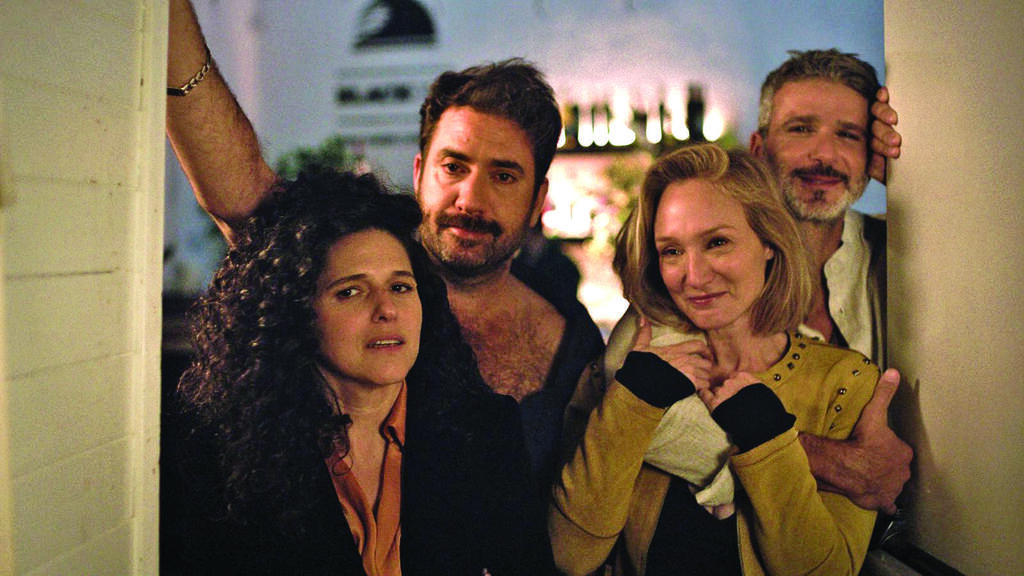
With Noa Koler, Avihu Pinhasov and Idan Haviv, in the TV series "Happy Place"
(Photo: Yaron Scharf, courtesy of Kan)
Years of trauma
To understand how Staviski reached this point, you have to go far back. She was born in the southern city of Arad, the youngest of three children. When she was seven, the family moved to Kfar Saba and later to Tzur Yigal.
Her father, a sculptor and art dealer, struggled for years with bipolar disorder and borderline personality disorder. “When I was 15, it erupted, but I lived in a kind of bubble and was not aware of what was really happening,” she recollects.
“My brothers protected me. After both of them enlisted in the army, I was left alone at home with my parents. When I was 17, my parents separated, and six months later, my brother told me we should vacate the house.
"I thought, okay, where should I go? I felt I could not live with my father nor with my mother. I moved in with a boyfriend I met at the time. From that moment, I felt it was just me and my brothers.
“To this day I think that if my father had cancer instead of a mental illness, we would not have been so alone, but we were. Three kids who had no idea what the hell was going on. My mother also went through a lot, but she was not involved. We had to take care of my father."
Beauty helped her build an independent economic life. At age 17, alongside waitressing jobs, she began modelling, entered the “Girl of the Year” contest, went on to roles in acting and hosting TV shows, and modelled in Japan, South Africa and New York.
Do you have a meaningful memory from that time?
“I remember how I stood on the stage in the ‘Girl of the Year’ contest, and instead of being excited, I was worried that my two parents were in the audience, wondering if they would get along, sitting next to each other."
Twenty‐one years ago, your father died by suicide after countless attempts.
“In those years my father tried to kill himself every other day in many ways, and each time my brothers and I would go out on a rescue mission. It took me many years to recover from the trauma, to stop reacting with panic whenever my brothers called,” she says, and flinches at the sound of a helicopter.
“That noise reminds me that we searched for my father with a helicopter in the Monkey Park, once among many. He was always angry when we saved him from himself."
How do you remember the day he took his life?
“I was 22. I had just come down from a fashion show by Dorin Frankfurt, and my phone was full of unanswered calls. My brothers were already waiting at home. My father’s family accused us of the fact that he killed himself. We asked ourselves what else we could have done. The three of us held a funeral and shiva alone, and my father’s family held a separate funeral and shiva.
“At some point we arrived at his house because we wanted to take some mementos. I walked through the hall and saw that the walls were decorated with framed pictures of mine from campaigns I participated in. Wow. I suddenly felt vulnerable being seen like that. I wanted to remove all the pictures from the house."
How is that connected to the fact that you stopped modelling at that period?
“Some time after his death, I got up to a shoot, and discovered that I had a giant cold sore on my lips and it hurt; that's when I understood that I didn’t want people to look at me anymore.
"I started self-searching. When we completed the shiva, I received a call from a therapist named Yaeli; she was truly an angel, and she is a significant part of my life to this day. She literally raised me.
"I knew I had been through trauma and I needed to take care of myself. When you’re in pain you are sure it will hurt forever, especially when you lose someone, and it’s a feeling of ‘I can’t live anymore.’ Today I say to my clients: ‘Agree to embrace the pain because it won’t hurt forever.’”
Looking back now, what are your thoughts on his decision?
“Lately, it’s become clear to me that you can’t help people who don’t want to help themselves, and you can’t save someone who doesn’t want to be saved. I miss him so much. He would have gone crazy for my daughters. I make sure to tell them about him."
Crumbs of love
For nearly 20 years, Staviski stayed out of the limelight (except for hosting a beauty show in 2018 on the Fashion Channel). She wasn’t acting or modeling, but instead built a career as a makeup artist.
She studied makeup at Natasha Denona’s makeup school and worked on campaigns and TV shows like “Dancing with the Stars” and “Master Chef.” “Milky,” the nickname she picked up while modeling in South Africa, became her professional name.
“When I was modeling in South Africa, I decided one day to tan and of course I got burned,” she explains. “A friend from Israel told me not to forget that I’m milk, and the nickname evolved into variations such as Milkyahu, Milkishuah.
"When I became a makeup artist, the name stuck. One day a client called my agent and said, ‘You made a mistake, we asked for Moran Milky, not Moran Staviski,’ and she told me we needed to merge the names. Since then, my professional name has been Moran Milky."
"I got my start in makeup by doing the most entry-level work, taking on every task that came my way, including ‘makeup’ for baby shoots, which is more about wiping runny noses.
"The fashion industry is famously hard to break into. They told me, ‘You came in as a model and knew everyone, it must have been easy for you.’ It was exactly the opposite! I had to prove myself twice as hard, and I did everything, even serving coffee for everyone."
And it was Bar Refaeli who gave you your first major opportunity more than 15 years ago.
“That’s a story I tell in my lectures now,” she says, smiling. “Bar didn’t know me. She had her own makeup artist. When I started, I worked on a FOX set where she was, but we had no interaction.
"Not long after, photographer Eyal Nevo called and offered me a gig with a limited budget: a shoot for Under Me, the underwear brand Bar launched with Dudi Balsar (which has since shut down). Eyal’s gut feeling (he had worked with Bar since she was a little girl) was that I could really connect with her.
“There was a click between us on that shoot. As simple as that. Not long after, FOX called and said, ‘Hey, we’re flying to Budapest to shoot the next campaign and Bar asked for you to do her makeup.’ I started working with her on X Factor and on international campaigns.
“She became a very good friend of mine. I learned a lot about myself from her. We really grew up together; we got married at the same time, had kids in the same years, and we’re still close friends today.
"If I need her, she’s right there for me. She’s not everyone’s friend, but when she is, it’s deep and true. She’s very candid; she doesn’t say one thing and mean another. What you see is what you get. It took me time to learn to appreciate that."
Two years ago, Staviski posted about the toxic relationship she was in, on and off, for nine years. That post opened the door for many women to share their own stories.
In her lecture “Makeup your Life,” she talks about that struggle and her journey growing up alone from age 15.
“At 28, I walked away from that relationship; it was the first time I chose myself,” she says, emotional. “That relationship went on and off since I was 19. I never felt it was important to tell who he was. Even when I posted about it, I felt it wasn’t about him but rather about me.
"It takes two to tango, and in a toxic relationship, there’s the person who brings the toxicity, but there’s also the one who stays and accepts for reasons rooted in childhood wounds. I don’t believe in blaming just one side. I guess I had to go through it."
Why did you stay for so long?
“Because I really didn’t believe I deserved anything better. I only knew how to survive on crumbs of love. I didn’t know what it was to have it all. I didn’t think I was smart, and he made sure to remind me by saying, ‘You’re a nobody,’ ‘You’ll never find anyone better than me,’ ‘You’re going nowhere.’ It was truly brainwashing, especially after being with him for so many years.
“The abuse was emotional, verbal, and financial. I racked up debt because I couldn’t work as a waitress or bartender; he wouldn’t allow it. His woman wasn’t going to be a bartender.
"There was this time when he was abroad, I did grocery shopping with his credit card. He called and asked why I spent money if he wasn’t in the country; who was I buying all this food for and who was I sleeping with while he was gone?
"I had a few hundred shekels in my wallet. I went back to the store, shaking, and asked them to cancel the charge and take my cash. That’s how scared I was. And still, that wasn’t the moment I said ‘enough.’ Every night before bedtime, my heart told me this wasn’t where I belonged."
How did you finally leave?
“It took a long time to build up to it. Then one morning, he called me ‘stupid,’ and I asked myself, 'After all I've been through as a child, is this what I want for my kids? A man who calls their mother stupid and a b****?
"That turning point wasn’t even for me. It was for the children I didn’t even have yet. I realized that this wasn’t the life I wanted for them."
Today, you understand that the relationship gave you a sense of stability you needed, but it had a price.
“Exactly. It wasn’t really stable; it was more like a swamp.”
She met Boaz, her partner and the father of her daughters (ages 11 and 7), a few months later. He owns Secret, a cosmetics and skincare company. She had just moved into her own rental apartment, burdened with debt but determined to stand on her own feet. By day she worked as a makeup assistant, by night as a bartender.
“He came into the bar where I was working, gave me his number, and I promised to call, but of course I didn’t. I didn’t know what I wanted at the time. Two weeks later, I saw him somewhere and said, ‘Hey,’ and he replied, ‘Hey? I'm sure you've got a good excuse.'
"I gave him my number, we set a date, and I canceled. Then we set another one, and I canceled again. A week later, I came back from a Shabbat dinner and called him. He asked if we could meet, came to pick me up, and we went on a date. He’s a handsome guy, accustomed to women being instantly drawn to him, but I had just come out of a bad relationship, and I protected myself."
“After the date, I expected what usually happened after all my dates, that he’d try to come up to my apartment, but instead, he gave me a quick kiss and said goodnight. After the second date, I called my sister and told her, ‘Start losing weight, I’m going to marry this guy.’
"Still, even after I moved in with him, I kept my apartment for more than six months until I could bring myself to break down another home. I didn’t have a safety net to fall back on, and I was really scared."
What’s the secret to your relationship?
“I’m married to a very sensitive man who accepts all the changes I go through. I take part in hippie and shamanic circles, and I can also travel to a designer’s runway show in L.A. I’m like a star spinning all over the place with loud music. My emotions are intense; I live life on full volume. Boaz is a businessman; he experiences things differently, but he really embraces it all."
No dream is too big
In recent years, Staviski embarked on a spiritual journey to heal old wounds. Alongside her longtime therapist, she enrolled in a wide range of personal development courses.
To the Reiki studies she began in her 20s, she added courses in transcendental meditation, cognitive coaching at Bar-Ilan University’s extension program, and a follow-up program specializing in relationships.
She continued with classes in the Yemima Method (a popular Israeli spiritual self-awareness technique), biographical coaching inspired by Steiner’s philosophy, and Tony Robbins' NLP training. Later, she studied with coach Maayan Ben Tzion, whose work changed her life and taught her she could achieve anything.
With that in mind, she enrolled in a yearlong Zoom-based training program at the school of British therapist Marisa Peer, who specializes in working with the subconscious.
“All my life, I believed I was very pretty and very good, but not very smart,” she says. “Through these studies, I discovered I’m intelligent. I’ve never stopped being passionate about makeup; I just wanted another channel for growth. I’m coming to you now straight from doing bridal makeup, and I love the work.
"I also have a presence on Instagram. I’m a beauty authority. No one really knows that I’ve been studying for years and now also work as a therapist. I’ve decided I want to merge my worlds instead of keeping them separate.
“In December, I’m launching two workshops in New York with Chaya Rosenzweig, a personal growth coach. There’s a center for children with special needs in New York, I plan to visit there to read my book to the children. No dream is too big for me anymore."
In the TV series “A Happy Place,” Staviski plays Ossi, the stoner and single best friend of Vered (Noa Koler), whose messy apartment includes a cockroach in an old yogurt cup. Ossi is also dating Yotam (Idan Haviv), a handsome emotional coach who throws Vered off balance.
How much of Ossi is in you?
“There were plenty of times I was the girl with the joint. I’m messy, not to Ossi’s level, but yeah, I live with kids at home. On the other hand, I’m not dirty, and my 15 years working with Bar Refaeli have made me even more obsessive about cleanliness. You’d look at my makeup bag and not believe how neat and sterile it is. Ossi has a real curiosity about life, and she’s honest."
"But she doesn’t seem interested in moving forward with her life, though. You’ve always wanted to move forward, even during tough times.
“And even in good times, I want to move forward. I’m on turbo. I’d never done a dramatic role before, and I really wanted to. Then I got this part, and it was just amazing.”
Why do you want it?
“I’ve always wanted to be an actress, you know. It’s not about money or fame. I’m already known and successful in my field, I don’t need outside validation. It’s something just for me. I even told Noa Koler, ‘Could you write me another role?"